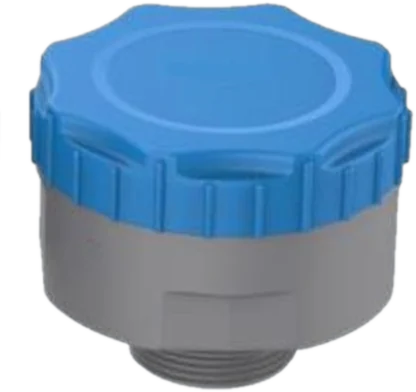
Measures the level without touching it.
60 GHz radar reads the distance to the surface from above, so nothing in the tank can clog, corrode or foul.
- 12 mrange
- ±2 mmaccuracy
- IP68sealed
- 0cables

Loading...
Sewage tank monitoring · IoTRICs
Know how full every tank is, when it needs emptying, and whether the tanker did the job.
Level now
20%4,400 L of 22,000 L
Example site: one 22,000 L tank, 3 pickups a day at AED 325 each.
A fast-filling tank is noticed only when it backs up into the car park.
Fixed schedules empty half-full tanks; emergency call-outs cost more.
Paying per trip with no way to see if the tank was fully emptied.
Opening manholes exposes staff to gases, and gives one reading, once.
Mon 03:00. The tank is 60% full. The tanker arrives. It leaves 30% behind. Flagged as a short-pump. The tank fills about 13% a day. The forecast learns its rhythm. Thu 07:20. 70%. The pump-out is booked, before critical. Thu 18:40. Emptied to 6%: a full clean, verified. 15,680 L removed.
Illustrative week. 22,000 L tank filling about 13% a day.
What it adds up to
Set the numbers for your own site and see what tanker pickups cost you, and what removing the unnecessary ones is worth.
Pump out at the right level and verify every clean, so the same volume moves in fewer trips. Our clients typically remove 1 in 3.
Estimates from your inputs. On site, the real fill rate and every pump-out come from the radar sensor.
Tanker pickups, per year
AED 354,900
That’s AED 9,760 a month, 360 fewer trips and ~13.5 t less CO₂ a year.
The sensor
60 GHz radar reads the distance to the surface from above, so nothing in the tank can clog, corrode or foul.
Fitted beneath the tank slab on a 1½" thread or bracket, looking straight down at the surface. No cables, no power supply, and set up from a phone over NFC or Bluetooth.
Long-range, low-power wireless (LPWAN) gets through slabs and car parks, with a cellular version where there’s no gateway. An external antenna is available for covered tanks.
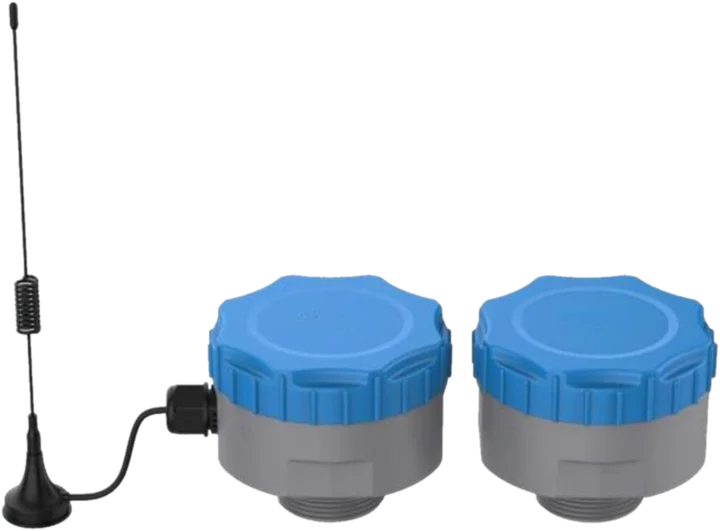
Nothing in the sewage to clog, corrode or foul.
Tuned for hot, humid, dirty tanks with steam and foam.
Fits small openings and ignores echoes from walls.
Flags a knocked or moved unit straight away.
Stores 2,000 readings and resends them after a signal drop.
Sealed IP68 housing, never in contact with sewage.
| Technology | 60 GHz mmWave radar, 8° beam, non-contact |
|---|---|
| Range | 0.3 m to 12 m, 1 mm resolution |
| Accuracy | ±2 mm still liquid · ±5 mm stable liquid |
| Wireless | Long-range LPWAN or cellular versions |
| Housing | IP68, PVDF, corrosion resistant |
| Environment | −40 °C to 70 °C, 0–100% RH |
| Mounting | 1½" thread or bracket · Ø101 × 87 mm |
| Setup | NFC and Bluetooth, remote updates |
Values per manufacturer datasheet.
How it works
A radar sensor mounted under the tank slab measures the distance to the surface, without touching sewage.
Long-range, low-power wireless (LPWAN) or cellular reaches basements and buried tanks. No cabling.
IoTRICs turns distance into % and litres, learns the tank’s fill pattern and forecasts every threshold.
Booking and critical alerts, one-tap pump-out requests, and every result verified.
What you get
01Day one
Current fill in % and litres, plus when it will hit 70% and 100%. On web and mobile.
For Facility managers
20% full 4,400 L of 22,000 L
At the usual rate it reaches 70% Sat 14 Nov at 11:44 and is full Tue 17 Nov at 09:29.
02Days ahead
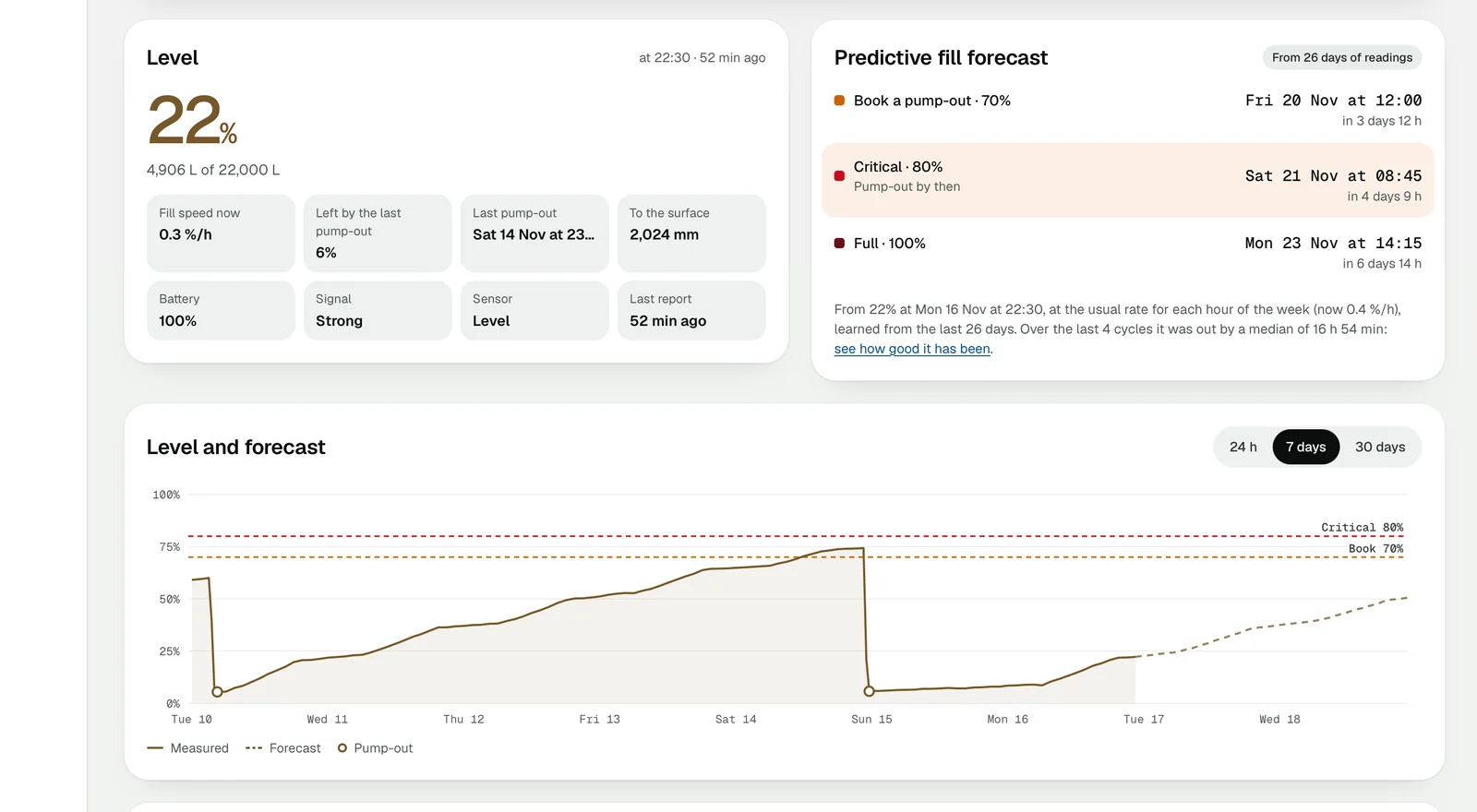
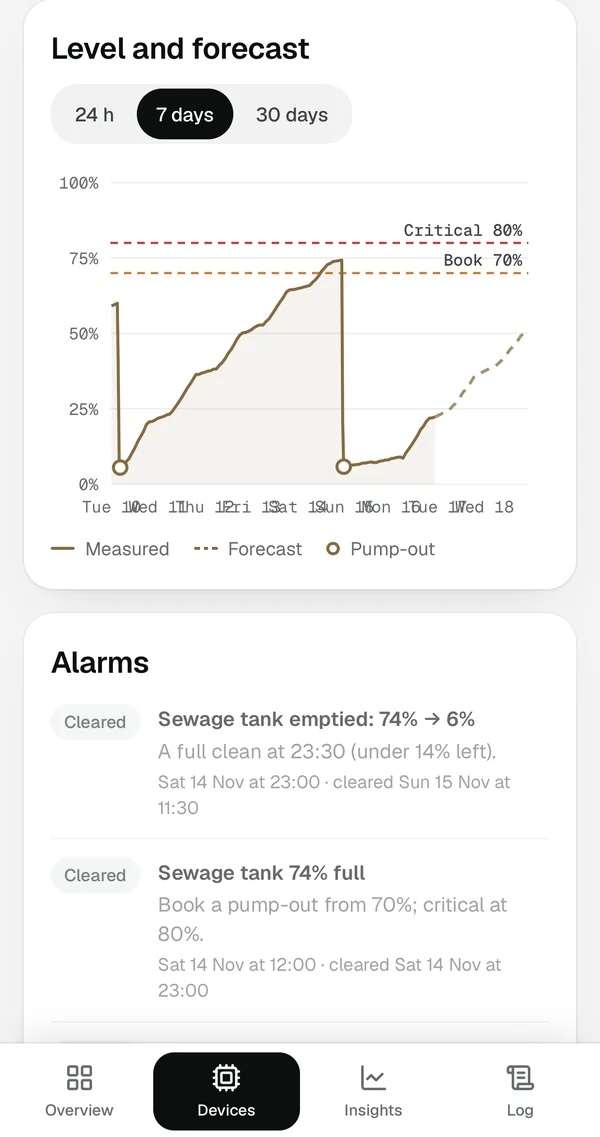
The forecast learns each tank and gives the booking date, the critical deadline and when it will be full.
For Facilities · Operations
Uses this tank’s usual fill rate for each hour of the week.
03At 70%
Booking and critical alerts reach the right people, and one tap sends the pump-out request to the contractor.
For Facilities
04After every visit
Detected from the level drop: before, after and litres removed. Visits that leave too much behind are flagged.
For Finance · Procurement
| Emptied | Level | Taken | Result |
|---|---|---|---|
| Tue 10 Nov 04:29 | 60% → 6% | 11,979 L | Full clean |
| Thu 5 Nov 21:30 | 72% → 17% | 12,243 L | Short-pumped |
| Mon 2 Nov 01:29 | 25% → 6% | 4,213 L | Full clean |
| Sat 31 Oct 03:29 | 51% → 6% | 9,911 L | Full clean |
05Every month
Daily fill, time between pump-outs, when the tanker comes and how many days ran high.
For Facilities · Finance
Pump-outs each week
Move from fixed schedules to fewer, fuller pump-outs, and size the tanker contract on the real pattern.
06Every cycle
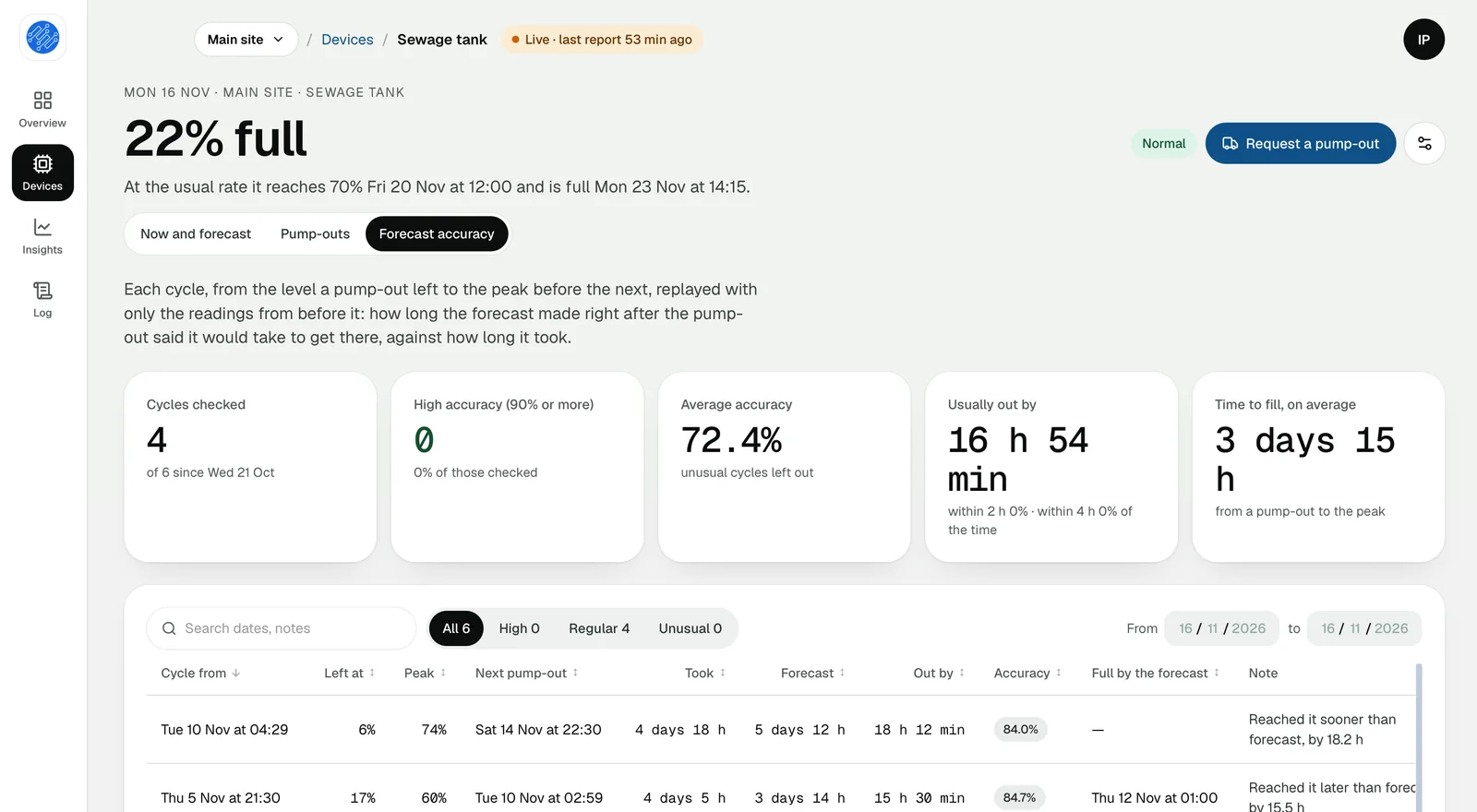
Each cycle is replayed with past data only and compared to reality, so you can see how far to trust it.
For Facilities
From a new installation with four cycles checked. Accuracy builds as more cycles are recorded.
IoTRICs platform
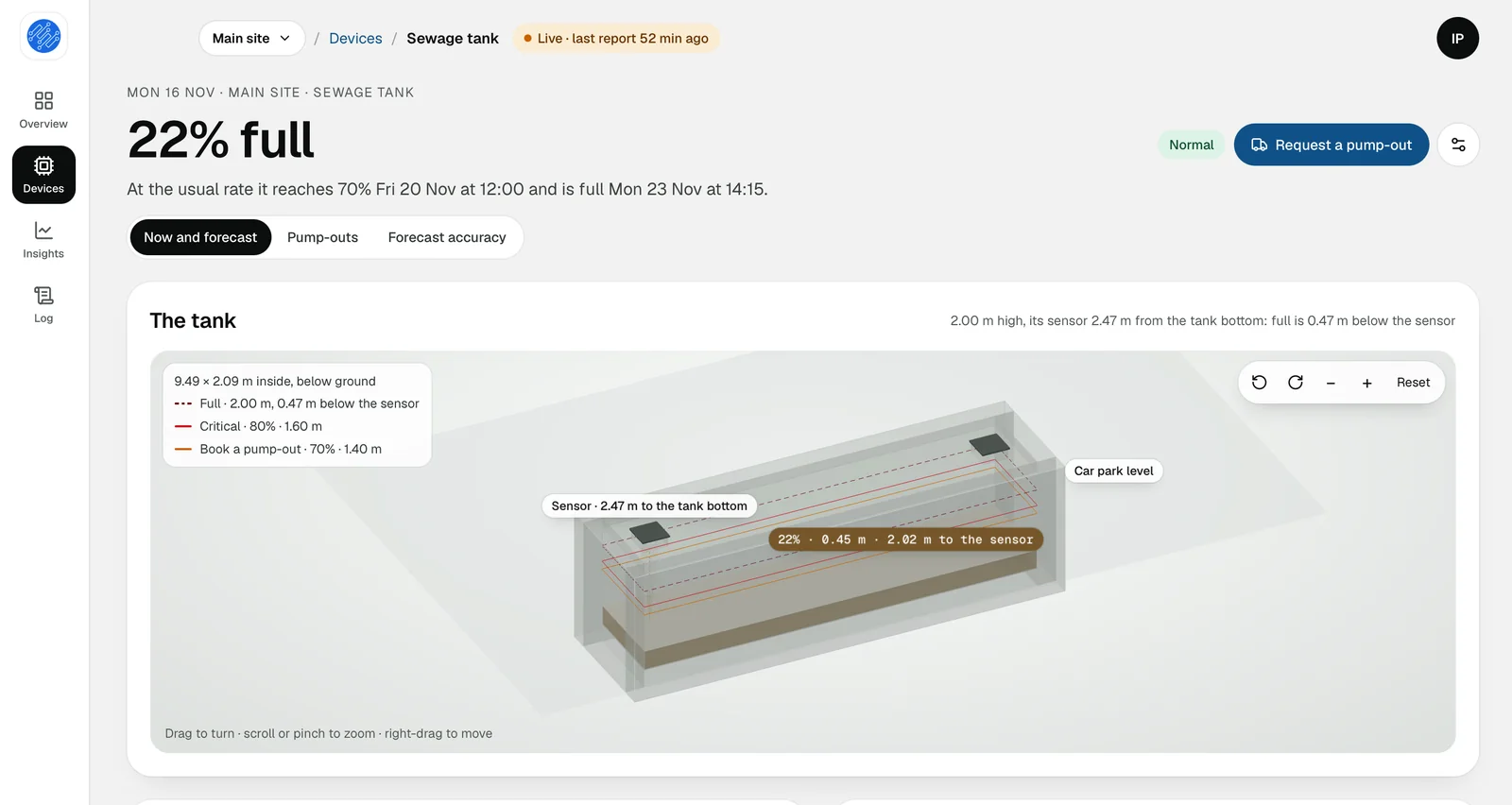
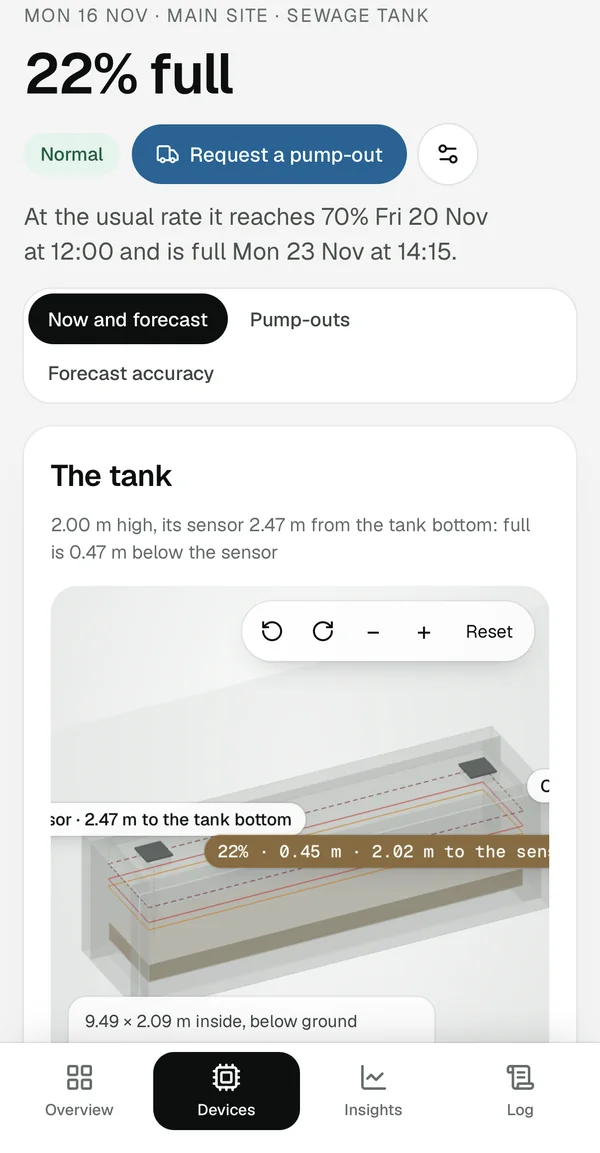
A 3D twin of every tank, the fill forecast, every pump-out and how far the forecast can be trusted. On web and mobile.
What changes for the facility team
From our deployments
Three sites, three problems, one sensor.
Use case 1 · Right-timed pickups
Emptied at 40–50% full, by habit.
Called at 70%. Each tanker leaves full.
AED 15,600–18,200 a year
~52 fewer pickups · ~2 t CO₂ avoided
Use case 2 · No more short-pumping
Every visit left 30% or more behind.
Every pump-out checked for a full clean.
AED 109,500–127,750 a year
~365 fewer pickups · ~13.7 t CO₂ avoided
Use case 3 · Overflows stopped
Emergency tankers, cleanup, odour and complaints.
Pickups booked days ahead from the forecast.
Solved overflow problem
No emergency call-outs · no cleanup · no complaints
Use cases 1 and 2 at AED 300–350 a pickup. CO₂ assumes a ~40 km round trip, 35 L/100 km and 2.68 kg CO₂ per litre (~37.5 kg a trip); ~22 kg CO₂ per tree a year.
Where it fits
Basement and car-park tanks awaiting sewer connection.
High occupancy, fast-filling tanks, costly overflows.
Busy sites where odour or backup reaches guests.
Septic and effluent tanks across one or many plots.
Farms, camps and construction sites with no sewer.
FM and property firms watching many tanks in one view.
Solution as a Service
No upfront sensor purchase. Sensor, platform and support in one subscription.
Included
Good to know
Weigh one monthly fee per tank against tanker pickups that can reach AED 29,575 a month at a single busy site.
Getting started
Tank size, access point and gateway position.
Wireless: mounted under the slab, set up from a phone.
Tank model, alert levels and who is notified.
Level, alerts and pump-out log from day one.
Accuracy grows as more fill cycles are learned.
No. The NT410-RDR is a 60 GHz radar that measures the distance to the surface from above. Nothing goes into the sewage, so there is nothing to clog, corrode or foul.
No. The sensor is fully wireless and self-powered. It mounts under the tank slab on a 1½" thread or bracket, and is set up from a phone over NFC or Bluetooth.
Yes. Long-range, low-power wireless (LPWAN) reaches basements and buried tanks, there is an external antenna option for covered tanks, and a cellular version where there is no gateway. If the signal drops, it stores up to 2,000 readings and resends them.
From the level drop. Each pump-out is logged automatically with the level before and after and the litres removed. Visits that leave too much behind are flagged as short-pumps, and each contractor gets a running compliance score.
It learns the tank’s usual fill rate for every hour of the week and gives the booking date, the critical deadline and when it will be full. Every cycle is replayed with past data and compared to reality, so accuracy is shown openly and improves as more fill cycles are recorded.
It depends on how often tankers come and what each trip costs. Our clients typically remove 1 in 3 tanker trips, by emptying at the right level and verifying every clean. At 3 pickups a day and AED 325 a pickup, that is about AED 117,000 a year at one site. Use the estimator above with your own numbers.
As a subscription under our SolaaS model: one monthly fee per tank covering the sensor, platform and support. For large projects, PaaS lets you own the hardware and license the platform. A proof of concept is available where needed.
We survey the site, install the sensor and put your tank live on the dashboard, with forecasts building from the first week.