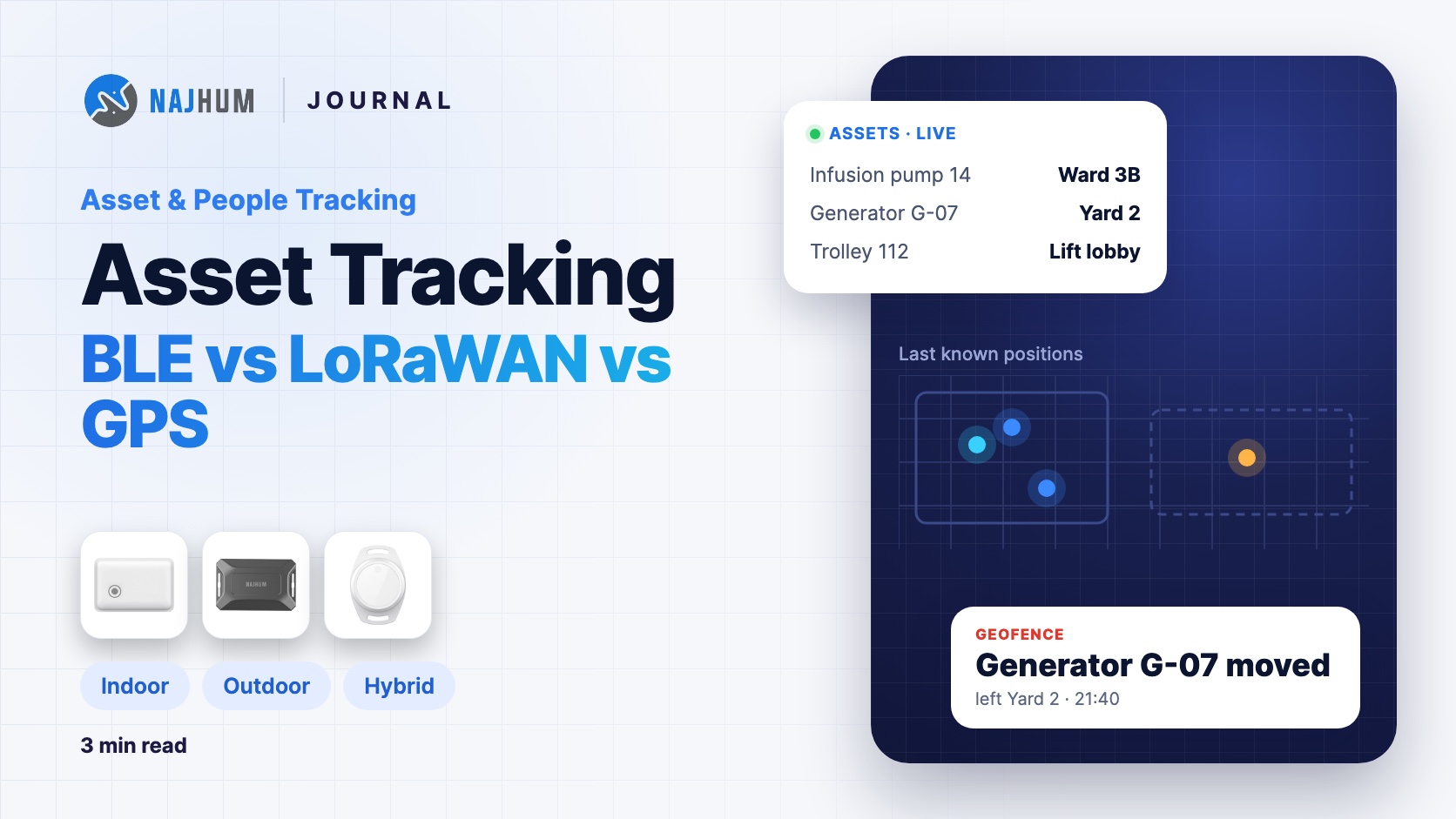
“Where is it?” is one of the most expensive questions in operations. Hospitals search for infusion pumps, contractors search for generators, warehouses search for pallets, and universities search for shared equipment. Asset tracking answers the question automatically, but the right technology depends on where the assets are and how precisely you need to find them.
Key takeaways
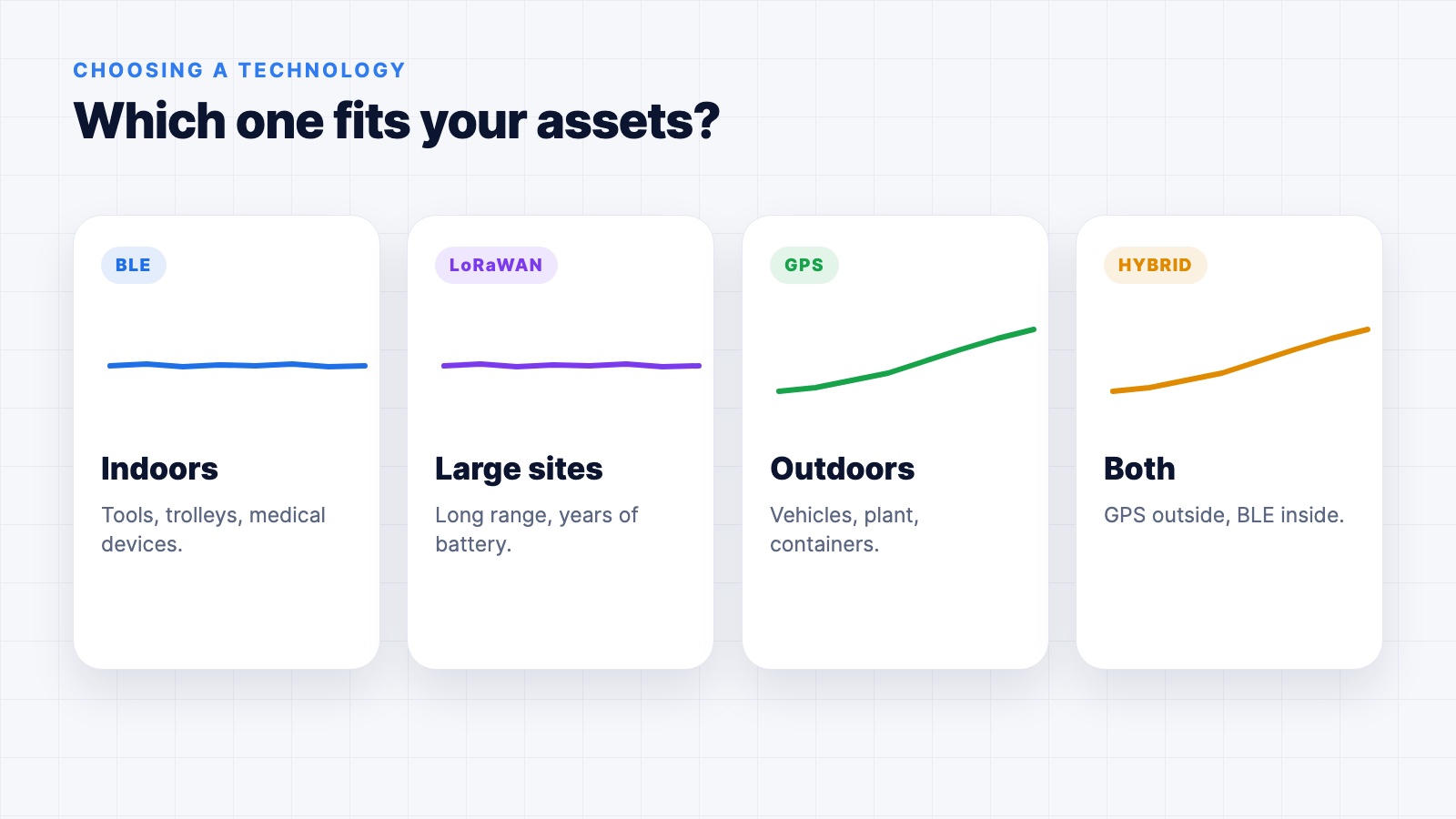
BLE suits indoor equipment at room or zone level.
LoRaWAN covers large sites with long battery life.
GPS gives accurate outdoor positions for moving assets.
Hybrid trackers combine them into one map.
Bluetooth Low Energy (BLE): indoors and up close
BLE tags are small, inexpensive and run for years on a battery. Receivers placed around a building pick up the tags and estimate their location based on signal strength.
Best for: indoor equipment, tools, trolleys, medical devices.
Accuracy: room or zone level with standard setups; more precise with angle-of-arrival systems.
Considerations: needs receivers or anchors in each area you want to cover.
LoRaWAN: long range, low power
LoRaWAN is a wireless technology designed to send small amounts of data over long distances using very little power. A single gateway can cover a large site, including basements and yards.
Best for: large campuses, yards, industrial sites, and as the backbone that carries location data from trackers.
Accuracy: on its own, approximate; combined with GPS or BLE, it delivers precise positions with long battery life.
Considerations: designed for periodic updates rather than continuous live tracking.
Where is it? One of the most expensive questions in operations.
GPS: outdoors and on the move
GPS gives accurate outdoor positions anywhere with sky view. It uses more power than BLE, so trackers either have larger batteries, external power, or only take a fix when the asset moves.
Best for: vehicles, trailers, containers, plant and equipment across sites.
Considerations: does not work reliably indoors or underground.
Combining them: the hybrid approach
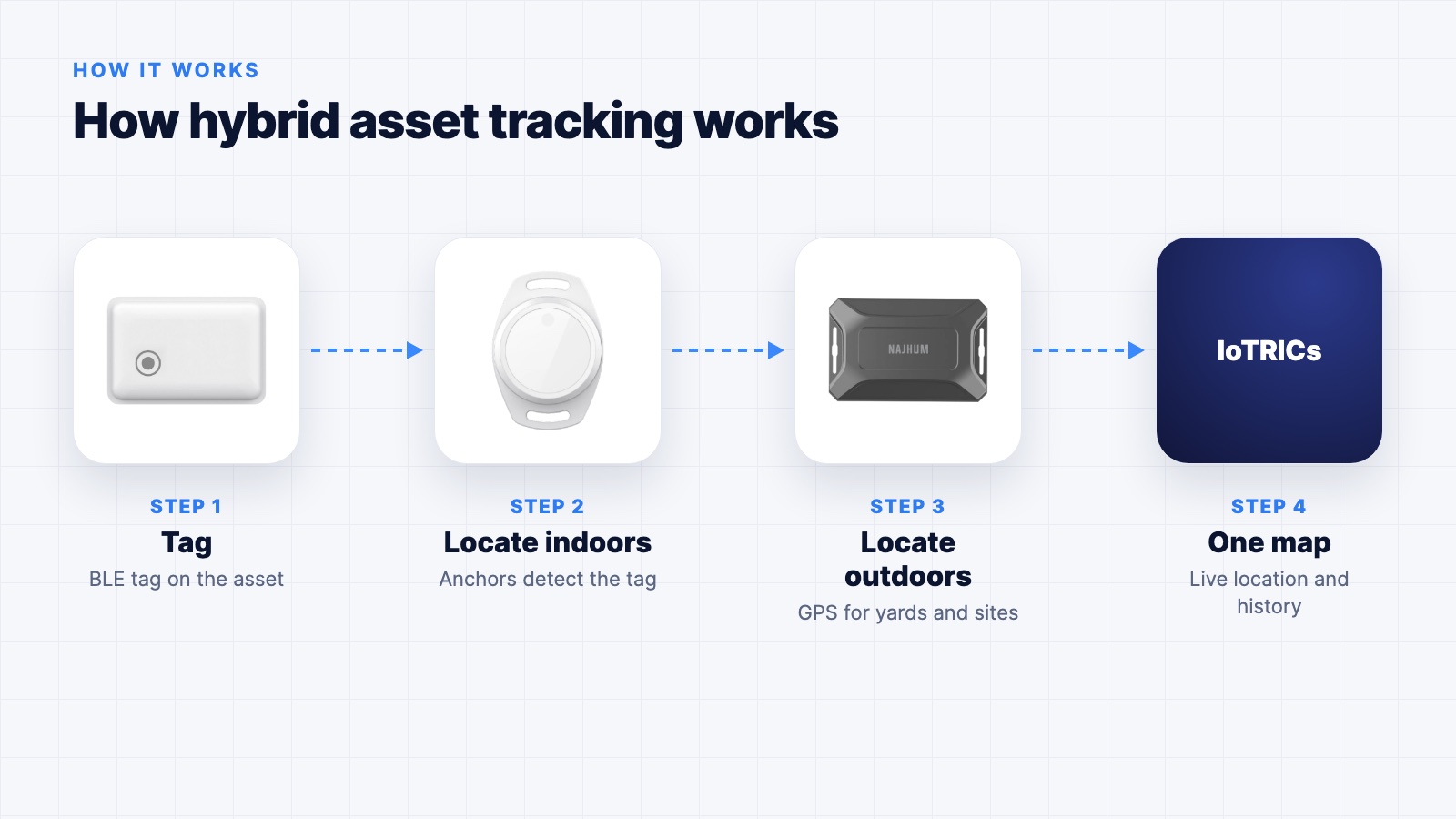
Most real sites mix indoor and outdoor areas, so the most effective setups combine technologies. A hybrid tracker can use GPS outdoors, switch to BLE beacons when it enters a building, and send its location over LoRaWAN or cellular. The user sees one map and one location history, regardless of which technology produced the fix.
Questions that decide the design
How precise does the location need to be: building, zone, room or shelf?
How often does the asset move, and how quickly do you need to know?
What size and mounting options does the asset allow for a tag?
Are there special conditions, such as high temperatures or sterilisation?
The answers usually point to a clear mix of tags and infrastructure, which is what a site survey produces.
Frequently asked questions
How accurate is BLE tracking?
Room or zone level with standard setups, and more precise with angle-of-arrival systems.
Does GPS work indoors?
Not reliably. Hybrid trackers switch to BLE beacons when they enter a building.
How long do tag batteries last?
BLE tags typically run for years; GPS trackers last longer when they only take a fix on movement.
Find the right tracking mix for your site.
See our asset tracking solution, or discuss your project with Najhum.